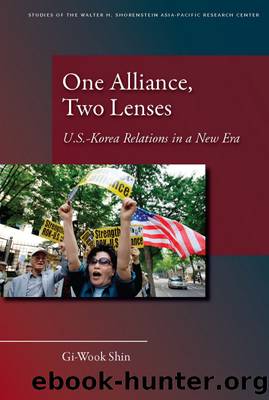
One Alliance, Two Lenses: U.S.-Korea Relations in a New Era by Gi-Wook Shin
Author:Gi-Wook Shin [Shin, Gi-Wook]
Language: eng
Format: epub
Tags: International Relations, Political Science, General
ISBN: 9780804763691
Google: acKZaB4RlGEC
Goodreads: 7752828
Publisher: Stanford University Press
Published: 2010-01-27T00:00:00+00:00
Historical Context
Virtually from the beginning of its existence, the DPRK has been an enemy of the United States, whether as a satellite of the Soviet Union and/or as a threat to South Korea. At the end of World War II, as Japan surrendered, Soviet troops marched across Manchuria and onto the northern part of the Korean peninsula. Faced with the possibility of Soviet occupation of the entire Korean peninsula, two young U.S. officers were charged with demarcating a U.S. zone of occupation at an all-night meeting in Washington on August 10, 1945. âWorking in haste and under great pressure, and using a National Geographic map for reference,â noting both the location of Seoul and the midpoint of the peninsula, distinguished journalist and Korea watcher Don Oberdorfer recounts, they chose the thirty-eighth parallel as the line to hold back Soviet occupation. The Soviets heeded this decision and stopped their advance. No Koreans or even experts on Korea were consulted.11
By the fall of 1948, both the Republic of Korea (ROK) and the DPRK had been established and their leaders had been installed by the two great cold war powers. Soon after, Soviet military forces withdrew from the peninsula, and in the summer of 1949, U.S. troops followed suit, pulling back from the ROK. Only one year later, the North, backed by the Soviet Union and the Peopleâs Republic of China, invaded the South. In this brutal war, all parties incurred tremendous loss of life, including the United States, and the peninsula was left in a state of devastation. Even after fighting ceased in July 1953, the two sides technically remained at war in the absence of a peace accord, and there was great fear that the North might try again to reunite the peninsula through military force. The U.S.-ROK alliance, forged in blood, became a strategic feature of the Asia-Pacific, a bulwark against Northern aggression and communist domination of the peninsula.
Rather than launch another all-out military attack, however, North Korea turned to terrorist tactics to undermine the South, attempting to assassinate President Park in 1968 (succeeding in killing his wife in 1974), bombing senior South Korean officials in Rangoon in a failed assassination attempt on President Chun Doo Hwan in 1983, and bombing a South Korean passenger flight (Korean Airlines [KAL] 858) returning home from the Middle East in 1987. Grave American mistrust of the DPRK also intensified through direct U.S.-DPRK confrontations, including the DPRKâs 1968 capture of the USS Pueblo, a U.S. Navy intelligence ship, and its crew (whom North Korea held hostage for nearly a year) and confrontations along the demilitarized zone (DMZ) that resulted in the deaths of U.S. soldiers. These and other instances of aggression against South Korea and the United States reinforced the American perception that North Korea was an irrational international outlaw bent on aggressive actionâan extremely dangerous actor beyond even Moscowâs control.12 North Korea came to be considered âthe poster child for rogue states.â13
Even before the United States officially designated North Korea as a state
Download
This site does not store any files on its server. We only index and link to content provided by other sites. Please contact the content providers to delete copyright contents if any and email us, we'll remove relevant links or contents immediately.
| Arms Control | Diplomacy |
| Security | Trades & Tariffs |
| Treaties | African |
| Asian | Australian & Oceanian |
| Canadian | Caribbean & Latin American |
| European | Middle Eastern |
| Russian & Former Soviet Union |
The Secret History by Donna Tartt(19088)
The Social Justice Warrior Handbook by Lisa De Pasquale(12190)
Thirteen Reasons Why by Jay Asher(8910)
This Is How You Lose Her by Junot Diaz(6887)
Weapons of Math Destruction by Cathy O'Neil(6280)
Zero to One by Peter Thiel(5802)
Beartown by Fredrik Backman(5754)
The Myth of the Strong Leader by Archie Brown(5507)
The Fire Next Time by James Baldwin(5446)
How Democracies Die by Steven Levitsky & Daniel Ziblatt(5219)
Promise Me, Dad by Joe Biden(5153)
Stone's Rules by Roger Stone(5088)
A Higher Loyalty: Truth, Lies, and Leadership by James Comey(4964)
100 Deadly Skills by Clint Emerson(4925)
Rise and Kill First by Ronen Bergman(4789)
Secrecy World by Jake Bernstein(4753)
The David Icke Guide to the Global Conspiracy (and how to end it) by David Icke(4720)
The Farm by Tom Rob Smith(4512)
The Doomsday Machine by Daniel Ellsberg(4490)
